
8 · PDHG for a conic program#
Goal: build a small linear program over the nonnegative orthant from
SpaceCore spaces, a custom constraint operator and proximal functionals.
Then solve it with a hand-written primal–dual hybrid gradient (PDHG) loop
and certify the answer against scipy.optimize.linprog.
Before you start: read 2 · Linear algebra: spaces, operators, conjugate gradients and 3 · Functionals and gradient descent. Run the blocks in order in a fresh session; see Tutorials for setup.
1 · The program and its spaces#
Put probability mass x on n grid points \(t_i\in[0,1]\). Each point has a cost \(c_i\); the mass must sum to one and have mean \(\mu\):
This is a conic program with the orthant as cone: a linear program in standard form. The primal x lives in \(X=\mathbb{R}^n\), the multiplier y of the two equalities in \(Y=\mathbb{R}^2\).
import numpy as np
import matplotlib.pyplot as plt
from scipy.optimize import linprog
import spacecore as sc

ctx = sc.Context(sc.NumpyOps(), dtype=np.float64)
ops = ctx.ops
n, mu = 8, 0.4
grid = np.linspace(0.0, 1.0, n)
t = ctx.asarray(grid)
c = ctx.asarray(np.cos(3 * np.pi * grid) + grid)
b = ctx.asarray([1.0, mu])

X = sc.DenseCoordinateSpace((n,), ctx)
Y = sc.DenseCoordinateSpace((2,), ctx)
X.check_member(c)
Y.check_member(b)
assert grid[0] <= mu <= grid[-1]          # some x >= 0 has mean mu
The last assertion guarantees feasibility: mass split between the end points 0 and 1 attains any mean in between. Both spaces carry the Euclidean inner product, so the orthant projection below is coordinatewise and the adjoint is the transpose.
2 · The constraint operator from cores#
The adjoint of A follows from expanding the pairing:
A subclass of sc.LinOp writes these two maps as check-free cores;
the inherited apply, rapply and A.H check their inputs and
call them.
class MomentOp(sc.LinOp):
    """x -> (sum x, sum t x): total mass and first moment on a grid."""

    _fields = ("t", "dom", "cod", "ctx")
    _dynamic = ("t",)

    def __init__(self, t, dom, cod, ctx=None, check_level=None):
        super().__init__(dom, cod, ctx, check_level=check_level)
        self.t = self.ctx.asarray(t)

    def _apply_core(self, x):
        return self.ops.stack([self.ops.sum(x), self.ops.sum(self.t * x)])

    def _rapply_core(self, y):
        return y[0] + y[1] * self.t

A = MomentOp(t, X, Y)

rng = np.random.default_rng(0)
x_test = ctx.asarray(rng.standard_normal(n))
y_test = ctx.asarray(rng.standard_normal(2))
np.testing.assert_allclose(Y.inner(A.apply(x_test), y_test),
                           X.inner(x_test, A.H.apply(y_test)), atol=1e-12)
A_dense = np.vstack([np.ones(n), grid])
np.testing.assert_allclose(A.to_dense(), A_dense)
The first assertion is the adjoint identity on random elements; the
second compares the materialised operator with the 2 × n matrix written
by hand. PDHG never uses A_dense; linprog does in section 6.
3 · Objective and constraints as proximal functionals#
Write the program as \(\min_x G(x)+F(Ax)\) with
Here \(\iota_S\) is zero on S and \(+\infty\) off it. PDHG needs \(\operatorname{prox}_{\tau G}\) and \(\operatorname{prox}_{\sigma F^*}\). SpaceCore has a prox rule for an indicator, namely the set’s projection, but none for a sum with a linear term. Completing the square gives the shift instead:
For \(F^*\), F.conjugate_prox applies the Moreau identity
\(\operatorname{prox}_{\sigma F^*}(w)=w-\sigma\operatorname{prox}_{F/\sigma}(w/\sigma)=w-\sigma b\).
The singleton \(\{b\}\) is not built in, so we write it as a Set.
class Point(sc.Set):
    """The closed convex set {p} in its ambient space."""

    _fields = ("p", "ambient", "check_level")
    is_convex = True

    def __init__(self, p, ambient, *, check_level=None):
        super().__init__(ambient, check_level=check_level)
        self.p = p

    def contains(self, y):
        return self.ops.xp.all(y == self.p)

    def project(self, y):
        return self.p

linear = sc.InnerProductFunctional(c, X)
K = sc.IndicatorFunctional(sc.NonnegativeOrthant(X))
F = sc.IndicatorFunctional(Point(b, Y))

try:
    (linear + K).prox(x=c, step=0.5)
except sc.CapabilityError:
    pass
else:
    raise AssertionError("a sum with a linear term has no prox rule")

def prox_G(v, tau):
    return K.prox(x=X.axpy(-tau, c, v), step=tau)

v, tau = ctx.asarray(rng.standard_normal(n)), 0.3
z = prox_G(v, tau)
g = X.add(c, X.scale(1 / tau, X.axpy(-1.0, v, z)))   # c + (z - v) / tau
assert K.value(z) == 0.0 and np.all(g >= -1e-12)
np.testing.assert_allclose(z * g, 0.0, atol=1e-12)

w, sigma = ctx.asarray([0.3, -2.0]), 0.7
np.testing.assert_allclose(F.conjugate_prox(w, sigma), Y.axpy(-sigma, b, w))
assert F.value(b) == 0.0 and F.value(w) == np.inf
The try block confirms that SpaceCore refuses the sum rather than
guessing. The next three assertions are the optimality conditions of
the shifted prox: \(z\geq0\), \(g=c+(z-v)/\tau\geq0\) and
\(z_ig_i=0\), i.e. \(-g\in N_{\mathcal{K}}(z)\). The last two
check the Moreau formula and the indicator’s values.
4 · Step sizes from the operator norm#
PDHG with extrapolation one converges for \(\tau\sigma\|A\|^2<1\) when a saddle point exists (Chambolle & Pock, “A First-Order Primal-Dual Algorithm for Convex Problems with Applications to Imaging”, Algorithm 1 and Theorem 1). Since \(\|A\|^2\) is the top eigenvalue of \(A^\#A\), power iteration on the composed operator estimates it.
norm_sq = sc.power_iteration(A.H @ A, tol=1e-12, maxiter=500).eigenvalue
np.testing.assert_allclose(norm_sq, np.linalg.norm(A_dense, 2) ** 2, rtol=1e-10)
tau = sigma = 0.95 / float(np.sqrt(norm_sq))
assert tau * sigma * norm_sq < 1
A.H @ A is a lazy composite of the custom operator and its adjoint;
no 8 × 8 matrix is formed for the estimate.
5 · The PDHG loop#
One iteration reads
The dual of the program is \(\max_y -\langle b,y\rangle\) subject to \(s=c+A^\#y\geq0\). Stop when three residuals are small: primal infeasibility \(\|Ax-b\|\), dual infeasibility \(\|s-\max(s,0)\|\), and the gap \(|\langle c,x\rangle+\langle b,y\rangle|\).
x, y = X.zeros(), Y.zeros()
history = []
for k in range(20000):
    x_new = prox_G(X.axpy(-tau, A.H.apply(y), x), tau)
    x_bar = X.axpy(-1.0, x, X.scale(2.0, x_new))
    y = F.conjugate_prox(Y.axpy(sigma, A.apply(x_bar), y), sigma)
    x = x_new

    s = X.add(c, A.H.apply(y))
    primal = float(Y.norm(Y.axpy(-1.0, b, A.apply(x))))
    dual = float(X.norm(X.axpy(-1.0, K.prox(x=s, step=1.0), s)))
    gap = abs(float(linear.value(x) + Y.inner(b, y)))
    history.append((primal, dual, gap))
    if max(primal, dual, gap) < 1e-9:
        break
else:
    raise RuntimeError("PDHG tolerance not reached")

print("iterations:", k + 1)
print("x:", np.round(x, 6))
print("objective:", float(linear.value(x)))

fig, ax = plt.subplots(figsize=(6.4, 3.8))
for series, label in zip(np.array(history).T,
                         ["primal  $\\|Ax-b\\|$", "dual  $\\|\\min(s,0)\\|$",
                          "gap  $|\\langle c,x\\rangle+\\langle b,y\\rangle|$"]):
    ax.semilogy(series, label=label)
ax.set_xlabel("iteration"); ax.set_title("PDHG residuals"); ax.legend()
plt.show()
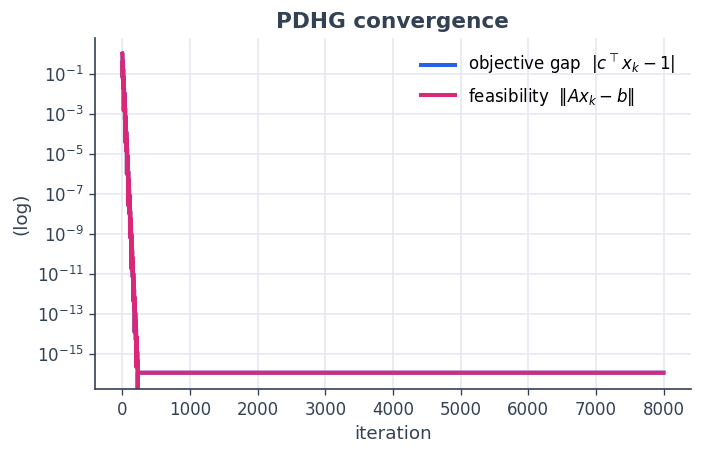
Every primal iterate is nonnegative, because it leaves K.prox; the
equality constraints and dual feasibility hold only in the limit. The
loop calls only space operations, the operator and its adjoint, and the
two prox maps.
6 · Certify against linprog#
A small gap alone does not certify optimality; it must come with primal
and dual feasibility. Assert all three, then compare with the HiGHS
solver in linprog on the dense matrix.
s = X.add(c, A.H.apply(y))
assert K.value(x) == 0.0
np.testing.assert_allclose(A.apply(x), b, atol=1e-8)
assert np.all(s >= -1e-8)
np.testing.assert_allclose(linear.value(x), -Y.inner(b, y), atol=1e-8)

reference = linprog(np.asarray(c), A_eq=A_dense, b_eq=np.asarray(b),
                    bounds=(0, None), method="highs")
assert reference.status == 0
np.testing.assert_allclose(linear.value(x), reference.fun, atol=1e-8)
np.testing.assert_allclose(x, reference.x, atol=1e-6)
np.testing.assert_allclose(y, -reference.eqlin.marginals, atol=1e-6)
print("support:", grid[x > 1e-6], "weights:", x[x > 1e-6])

fig, ax = plt.subplots(figsize=(6.4, 3.8))
ax.plot(grid, c, "o-", color="#94a3b8", label="cost $c_i$")
ax.plot(grid, -(y[0] + y[1] * grid), "--", color="#059669",
        label="dual line $-(y_0+y_1t)$")
ax.bar(grid, x, width=0.04, color="#db2777", label="optimal mass $x_i$")
ax.axvline(mu, color="#334155", lw=1)
ax.set_xlabel("t"); ax.set_title("Optimal mass and the supporting dual line")
ax.set_ylim(top=2.4); ax.legend(loc="upper left"); plt.show()
The dual slack \(s_i=c_i-\ell(t_i)\) with
\(\ell(t)=-(y_0+y_1t)\) is nonnegative, so the dual line lies under
every cost point. Complementarity \(x_is_i=0\) puts all mass on
points where the line touches. Here this is the two grid points
\(t=2/7\) and \(t=1\), with weights 0.84 and 0.16: their mean is
\(0.4=\mu\). The multiplier sign is opposite to linprog’s
eqlin.marginals because the saddle uses \(+\langle Ax,y\rangle\).
Check your understanding#
Why does
prox_Gsubtract \(\tau c\) before projecting rather than after? Shifting after the projection, \(\max(v,0)-\tau c\), leaves the orthant wherever \(c_i>0\) and \(v_i\leq0\).Why does the optimum use at most two grid points? A vertex of \(\{x\geq0,\ Ax=b\}\) has at most as many nonzeros as A has rows.
Set
tau = sigma = 1.5 / np.sqrt(norm_sq)and rerun section 5. The step condition fails; record whether the residuals still decrease.Replace
Point(b, Y)by a box \(\{l\leq y\leq u\}\) set to model inequality constraints \(l\leq Ax\leq u\). Onlyprojectandcontainschange in the set andF.conjugate_proxin the loop is unchanged; the gap must then use the support function of the box.
Next: 9 · Lazy operator algebra and fusion shows when an operator expression
such as A.H @ A is worth materialising.