
5 · Weighted Tikhonov: an inverse problem with metric adjoints#
Goal: build a weighted Tikhonov objective from functionals on two weighted spaces, check its gradient, and minimise it with a hand-written gradient descent whose answer matches the metric normal equations.
Before you start: read 2 · Linear algebra: spaces, operators, conjugate gradients and 3 · Functionals and gradient descent. Run the code blocks in order in a fresh session; see Tutorials for setup.
We deblur a noisy signal: we observe \(b \approx A x\), where A is a blur and the measurement noise is heteroscedastic. We recover x by minimising
The Y norm weights measurement i by its precision \(1/\sigma_i^2\); the X norm with weights m is a prior. Both norms are non-Euclidean, and that changes the adjoint of A.
import numpy as np
import matplotlib.pyplot as plt
import spacecore as sc

# Colours used in the plots below.
BLUE, INDIGO, CYAN = "#2563eb", "#4f46e5", "#0891b2"
PINK, AMBER, GREEN = "#db2777", "#d97706", "#059669"
SLATE, GRID = "#334155", "#e5e9f0"

ctx = sc.Context(sc.NumpyOps(), dtype=np.float64)
ops = ctx.ops
1 · The forward problem#
A clean signal \(x_\text{true}\) is blurred by a row-normalised Gaussian kernel and corrupted by noise whose standard deviation grows from 0.015 on the left to about 0.13 on the right.
n = 80
grid = np.arange(n)
x_true = (np.exp(-0.5*((grid - 24)/5)**2) + 0.7*np.exp(-0.5*((grid - 52)/3)**2))

blur = np.exp(-0.5*((grid[:, None] - grid[None, :]) / 3.0)**2)
M = blur / blur.sum(axis=1, keepdims=True)
sigma = 0.015 + 0.12 * (grid / n)**2                     # noise grows to the right
rng = np.random.default_rng(1)
clean = M @ x_true
b = clean + sigma * rng.standard_normal(n)

fig, ax = plt.subplots(figsize=(8.6, 3.8))
ax.fill_between(grid, clean - sigma, clean + sigma, color=AMBER, alpha=0.18,
                label="±1σ noise band")
ax.plot(grid, x_true, color=GREEN, lw=2.6, label="true signal $x_{true}$")
ax.plot(grid, clean, color=SLATE, lw=1.6, ls="--", label="blurred (noise-free)")
ax.plot(grid, b, color=BLUE, lw=1.0, marker="o", ms=2.5, alpha=0.8, label="measurements $b$")
ax.set_title("A blurred signal with growing measurement noise")
ax.set_xlabel("position"); ax.legend(loc="upper right"); plt.show()
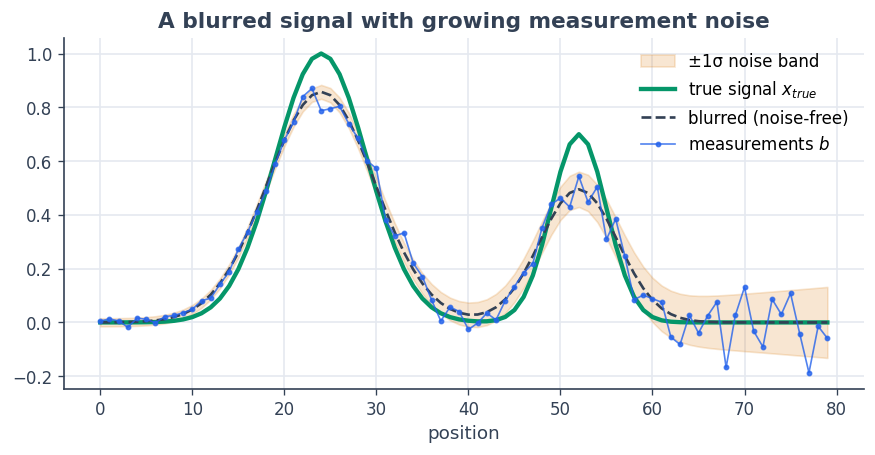
The right-hand measurements visibly scatter more than the left-hand ones; the Y weights will discount them.
2 · Weighted spaces and the operator#
Each space carries its geometry: WeightedInnerProduct(w) defines
\(\langle u,v\rangle=\sum_i w_iu_iv_i\). The operator stores the
same blur matrix M; only its endpoints know about the weights.
y_weights = ctx.asarray(1.0 / sigma**2)                  # measurement precision
x_weights = ctx.asarray(0.7 + 1.3 * grid / n)            # prior weights m
X = sc.DenseCoordinateSpace((n,), ctx, geometry=sc.WeightedInnerProduct(x_weights))
Y = sc.DenseCoordinateSpace((n,), ctx, geometry=sc.WeightedInnerProduct(y_weights))
A = sc.DenseLinOp(ctx.asarray(M), X, Y, ctx)
b_arr = ctx.asarray(b)
Y.check_member(b_arr)

u = ctx.asarray(rng.standard_normal(n))
np.testing.assert_allclose(Y.inner(u, u), np.sum(u**2 / sigma**2))
assert not X.is_euclidean and not Y.is_euclidean
The assertion confirms that Y.inner is the precision-weighted sum,
so Y.norm(A.apply(x) - b_arr)**2 is the first term of J.
3 · The metric adjoint is not the transpose#
The adjoint is defined by \(\langle Ax,y\rangle_Y=\langle x,A^\*y\rangle_X\). Writing both inner products with diagonal matrices \(G_X=\operatorname{diag}(m)\) and \(G_Y=\operatorname{diag}(1/\sigma^2)\) gives
A.H is this metric adjoint. The coordinate transpose \(A^\top\)
satisfies the identity only when both weights are all ones.
xr = ctx.asarray(rng.standard_normal(n))
yr = ctx.asarray(rng.standard_normal(n))
lhs = float(Y.inner(A.apply(xr), yr))
rhs_metric = float(X.inner(xr, A.H.apply(yr)))
rhs_transpose = float(X.inner(xr, ctx.asarray(M.T @ np.asarray(yr))))

np.testing.assert_allclose(lhs, rhs_metric, rtol=1e-10)
np.testing.assert_allclose(A.H.apply(yr), (M.T @ (np.asarray(yr) / sigma**2)) / np.asarray(x_weights))
assert abs(lhs - rhs_transpose) > 1e-3 * abs(lhs)
print(f"<Ax,y>_Y = {lhs:+.4f}   <x,A.H y>_X = {rhs_metric:+.4f}   <x,A^T y>_X = {rhs_transpose:+.4f}")
The first assertion is the defining identity; the second matches A.H
against the closed form \(G_X^{-1}A^\top G_Y\); the third shows that
the transpose fails the identity by far more than roundoff.
4 · Build the objective from functionals#
Split J into a data term pulled back through A and a regulariser:
R is SquaredL2NormFunctional(X). D needs the data b, so we write it as
a Functional with two check-free cores. The Riesz gradient of D in
the Y geometry is \(y-b\), because
\(D(y+h)-D(y)=\langle y-b,h\rangle_Y+O(\lVert h\rVert^2)\).
class WeightedMisfit(sc.Functional):
    """D(y) = 1/2 ||y - b||_Y^2 on a weighted coordinate space Y."""

    _fields = ("b", "dom", "ctx")
    _dynamic = ("b",)

    def __init__(self, b, dom, ctx=None, check_level=None):
        super().__init__(dom, ctx, check_level=check_level)
        self.b = self.ctx.asarray(b)
        self.domain.check_member(self.b)

    def _value_core(self, y):
        r = y - self.b
        return 0.5 * self.domain.inner(r, r)

    def _grad_core(self, y):
        return y - self.b          # Riesz gradient in Y, not G_Y (y - b)

lam = 10.0
data_term = WeightedMisfit(b_arr, Y)
objective = data_term @ A + lam * sc.SquaredL2NormFunctional(X)

try:
    data_term.value(ctx.asarray(np.zeros(n + 1)))
except sc.SpaceValidationError as error:
    print("rejected:", error)
else:
    raise AssertionError("a wrong-shaped input must be rejected")
The class defines only _value_core and _grad_core; the public
value and grad it inherits check membership before calling them,
which is why the 81-entry input is rejected. @ composes with A, and
+ and * come from the functional algebra. lam = 10 is the
regularisation strength used throughout; section 8 compares it with
other values.
5 · Check the gradient#
The chain rule applies the metric adjoint of the inner map, so
The first object is the Riesz gradient (objective.grad), an element
of X. The second is the coordinate covector that X.riesz returns; it
is what a coordinate-wise finite difference sees.
x0 = ctx.asarray(rng.standard_normal(n))
g = objective.grad(x0)
residual = A.apply(x0) - b_arr
np.testing.assert_allclose(g, X.add(A.H.apply(residual), X.scale(lam, x0)))
np.testing.assert_allclose(
    X.riesz(g), M.T @ (np.asarray(residual) / sigma**2) + lam * np.asarray(x_weights * x0))

d = ctx.asarray(rng.standard_normal(n))
h = 1e-6
slope = (objective.value(X.axpy(h, d, x0)) - objective.value(X.axpy(-h, d, x0))) / (2 * h)
np.testing.assert_allclose(slope, X.inner(g, d), rtol=1e-6)
assert abs(slope - np.dot(g, d)) > 1e-3 * abs(slope)
The finite-difference slope equals \(\langle\nabla J,d\rangle_X\) and not the plain dot product \(\nabla J\cdot d\): a Riesz gradient must be paired in the geometry of its space.
6 · Reference: the metric normal equations#
Setting \(\nabla J(x)=0\) gives \((A^\*A+\lambda I)x=A^\*b\).
The operator \(A^\*A+\lambda I\) is self-adjoint and positive
definite in the X geometry, so sc.cg applies; multiplying by
\(G_X\) gives the dense check \((A^\top G_YA+\lambda G_X)x=A^\top G_Yb\).
def tikhonov_solve(A, b_arr, X, lam):
    normal = A.H @ A + lam * sc.IdentityLinOp(X)
    return sc.cg(normal, A.H.apply(b_arr), tol=1e-12, maxiter=8*n, check_every=1)

res = tikhonov_solve(A, b_arr, X, lam)
x_hat = np.asarray(res.x)
Gx, Gy = np.diag(np.asarray(x_weights)), np.diag(np.asarray(y_weights))
x_dense = np.linalg.solve(M.T @ Gy @ M + lam * Gx, M.T @ Gy @ b)

assert bool(res.converged)
np.testing.assert_allclose(x_hat, x_dense, rtol=1e-8, atol=1e-10)
assert X.norm(objective.grad(res.x)) < 1e-8 * X.norm(objective.grad(X.zeros()))
print("cg iterations:", int(res.num_iters))
x_hat is the reference minimiser: it agrees with an independent
dense solve, and the composed objective’s gradient vanishes there.
7 · Minimise J with hand-written gradient descent#
J is a quadratic whose Hessian, in the X geometry, is \(N=A^\*A+\lambda I\). With step \(1/L\), where L is the largest eigenvalue of N, each step shrinks the error by at least the factor \(1-\lambda/L\), because the smallest eigenvalue of N is at least λ. We estimate L by power iteration in the X inner product.
normal = A.H @ A + lam * sc.IdentityLinOp(X)
v = X.scale(1.0 / X.norm(xr), xr)
for _ in range(100):
    w = normal.apply(v)
    v = X.scale(1.0 / X.norm(w), w)
L = float(X.inner(v, normal.apply(v)))

eig_ref = np.linalg.eigvals(np.linalg.solve(Gx, M.T @ Gy @ M) + lam * np.eye(n)).real
np.testing.assert_allclose(L, eig_ref.max(), rtol=1e-6)
print(f"L = {L:.1f},  L / lambda = {L / lam:.0f}")

def gradient_descent(grad, x, step, tol=1e-9, maxiter=50_000):
    g0 = X.norm(grad(x))
    for k in range(maxiter):
        g = grad(x)
        if X.norm(g) <= tol * g0:
            return x, k
        x = X.axpy(-step, g, x)
    raise RuntimeError("gradient tolerance not reached")

x_gd, iters = gradient_descent(objective.grad, X.zeros(), 1.0 / L)
np.testing.assert_allclose(x_gd, x_hat, rtol=0, atol=1e-6 * np.abs(x_hat).max())
print("gradient steps:", iters)
The Rayleigh quotient matches the largest eigenvalue of the dense matrix
\(G_X^{-1}A^\top G_YA+\lambda I\). The loop uses only X.axpy,
X.norm and objective.grad, stops on a relative gradient norm,
and lands on the normal-equations solution. Its several thousand steps
reflect the ratio \(L/\lambda\approx500\).
8 · The wrong adjoint converges to the wrong point#
Replace A.H by the coordinate transpose in the gradient formula:
\(g_\top(x)=A^\top(Ax-b)+\lambda x\). Its zero solves
\((A^\top A+\lambda I)x=A^\top b\), the unweighted Tikhonov problem.
At = sc.DenseLinOp(ctx.asarray(M.T), Y, X, ctx)          # transpose posing as adjoint

def transpose_grad(x):
    return X.add(At.apply(A.apply(x) - b_arr), X.scale(lam, x))

x_wrong, _ = gradient_descent(transpose_grad, X.zeros(), 1.0 / L)
x_euclid = np.linalg.solve(M.T @ M + lam * np.eye(n), M.T @ b)
np.testing.assert_allclose(x_wrong, x_euclid, rtol=0, atol=1e-6)
assert X.norm(X.add(x_wrong, X.scale(-1.0, x_gd))) > 0.5 * X.norm(x_gd)

def rel_err(x): return float(np.linalg.norm(x - x_true) / np.linalg.norm(x_true))

fig, ax = plt.subplots(figsize=(8.6, 3.9))
ax.plot(grid, x_true, color=GREEN, lw=2.8, label="true signal")
ax.plot(grid, x_wrong, color=PINK, lw=1.8, ls="--",
        label=f"transpose (unweighted),  rel. err {rel_err(x_wrong):.2f}")
ax.plot(grid, x_gd, color=BLUE, lw=2.2,
        label=f"metric adjoint,  rel. err {rel_err(x_gd):.2f}")
ax.set_title(f"Gradient-descent limits at λ = {lam:g}")
ax.set_xlabel("position"); ax.legend(loc="upper right"); plt.show()
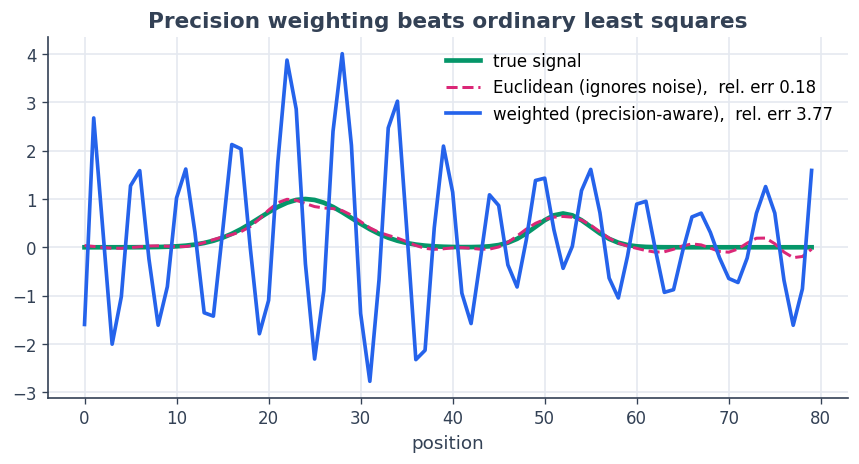
The wrong loop also converges, so convergence alone does not certify the gradient; only the checks of section 5 do. Its limit is the unweighted solution, and at λ = 10 that solution is heavily over-smoothed: dropping the precisions \(1/\sigma_i^2\in[57,4444]\) from the data term leaves the same λ far too strong relative to the misfit.
Choosing \(\lambda\): the L-curve#
Sweeping λ traces data misfit \(\lVert Ax-b\rVert_Y\) against solution size \(\lVert x\rVert_X\). A visible corner suggests a compromise; it is a heuristic, not a guarantee of minimum error.
lams = np.logspace(-2, 3, 18)
misfit, regn = [], []
for lm in lams:
    xl = tikhonov_solve(A, b_arr, X, lm).x
    misfit.append(float(Y.norm(A.apply(xl) - b_arr)))
    regn.append(float(X.norm(xl)))
assert np.all(np.diff(misfit) > 0) and np.all(np.diff(regn) < 0)

fig, ax = plt.subplots(figsize=(6.0, 4.4))
ax.loglog(misfit, regn, color=INDIGO, marker="o", ms=4)
k = int(np.argmin(np.abs(lams - lam)))
ax.scatter(misfit[k], regn[k], color=PINK, s=140, zorder=5,
           label=f"chosen λ = {lam:g}")
ax.set_xlabel(r"data misfit  $\|Ax-b\|_Y$"); ax.set_ylabel(r"solution norm  $\|x\|_X$")
ax.set_title("L-curve"); ax.legend(); plt.show()
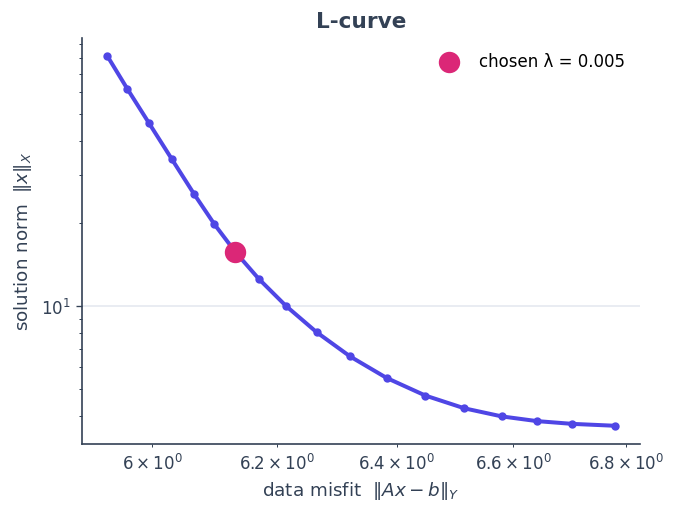
The assertion checks the monotone trade-off: larger λ increases the misfit and decreases the solution norm.
Check your understanding#
Multiply all measurement weights by 10. Which λ keeps the minimiser unchanged? λ times 10: then J itself is multiplied by 10.
Why does
WeightedMisfit._grad_corereturny - band noty_weights * (y - b)? The second is the covectorY.riesz(y - b); the section 5 assertions would fail with it.Run
gradient_descentwith the covector directionlambda x: X.riesz(objective.grad(x))and a step small enough to converge. Its limit isx_hat, unlike the transpose loop: the covector vanishes exactly where the gradient does.Set
lam = 5e-3and rerun from section 4. Expect L/λ near \(10^6\), so gradient descent no longer reaches the tolerance withinmaxiter, while CG still converges.
Next: 6 · Optimal transport builds an objective from functionals on a product space and maximises it with gradient ascent and backtracking.