
7 · Gradient descent on a manifold with non-Euclidean geometry#
Goal: build the unit sphere of a metric M, a quadratic objective, and its tangent projector, then minimise the objective with a hand-written Riemannian gradient descent and match the smallest generalized eigenpair of (A, M).
Before you start: read 3 · Functionals and gradient descent and 6 · Optimal transport: build the dual from functionals. Run the blocks in order in a fresh session; see Tutorials for setup.
1 · An ambient space whose geometry is M#
Fix a symmetric positive-definite matrix M on the coordinates of \(\mathbb{R}^3\) and give the ambient space the inner product
The Riesz map of this geometry multiplies by M and its inverse solves with M.
OperatorInnerProduct takes both maps as operators on the Euclidean
coordinate space, so the metric is declared once, on the space.
import numpy as np
import scipy.linalg
import matplotlib.pyplot as plt
import spacecore as sc

BLUE, PINK, CYAN, GREEN = "#2563eb", "#db2777", "#0891b2", "#059669"

ctx = sc.Context(sc.NumpyOps(), dtype=np.float64)
ops = ctx.ops
M = ctx.asarray([[2.0, 0.6, 0.0],
                 [0.6, 1.0, 0.0],
                 [0.0, 0.0, 1.3]])
coords = sc.DenseVectorSpace((3,), ctx)
metric = sc.DenseLinOp(M, coords, coords, ctx)
inverse_metric = sc.DenseLinOp(np.linalg.inv(M), coords, coords, ctx)
X = sc.DenseVectorSpace(
    (3,), ctx, geometry=sc.OperatorInnerProduct(metric, inverse_metric),
)

rng = np.random.default_rng(0)
u, w = ctx.asarray(rng.standard_normal(3)), ctx.asarray(rng.standard_normal(3))
np.testing.assert_allclose(X.inner(u, w), u @ M @ w)
np.testing.assert_allclose(X.riesz(u), M @ u)
np.testing.assert_allclose(X.riesz_inverse(X.riesz(u)), u)
assert not X.is_euclidean
coords is the Euclidean coordinate space that OperatorInnerProduct
requires as the domain of M. Every later inner product, norm and gradient on
X uses M without being told again.
2 · The M-sphere and its retraction#
The manifold is the unit sphere of this geometry, an ellipsoid in coordinates:
The tangent space is the M-orthogonal complement of x, obtained by differentiating the constraint. The retraction R maps any nonzero ambient point back to the sphere by normalising in the space norm.
def retract(y):
    return X.scale(1.0 / X.norm(y), y)

x0 = retract(ctx.asarray([0.2, -0.9, 0.3]))
X.check_member(x0)
np.testing.assert_allclose(X.inner(x0, x0), 1.0)
np.testing.assert_allclose(x0 @ M @ x0, 1.0)
X.norm is the M-norm, so the retracted point has unit M-norm and
generally not unit Euclidean norm. Points on the manifold are ordinary
members of X; the constraint is enforced by the retraction, not by the space.
3 · The objective as a custom functional#
Take a symmetric matrix A and the objective
The coordinate derivative Ax is a covector: it pairs with v as
\((Ax)^\top v\). The metric gradient is the vector g with
\(\langle g,v\rangle_M=(Ax)^\top v\), which is riesz_inverse(A x).
On the sphere, \(2f(x)\) is the generalized Rayleigh quotient
\(x^\top Ax/x^\top Mx\).
A = ctx.asarray([[3.0, 1.0, 0.0],
                 [1.0, 2.0, 0.5],
                 [0.0, 0.5, 1.0]])

class HalfQuadratic(sc.Functional):
    """f(x) = x^T A x / 2 in coordinates, with the gradient in the space's metric."""

    _fields = ("A", "dom", "ctx")
    _dynamic = ("A",)

    def __init__(self, A, dom, ctx=None, check_level=None):
        super().__init__(dom, ctx, check_level=check_level)
        self.A = self.ctx.asarray(A)

    def _value_core(self, x):
        return 0.5 * self.ops.vdot(x, self.ops.matmul(self.A, x))

    def _grad_core(self, x):
        return self.domain.riesz_inverse(self.ops.matmul(self.A, x))

f = HalfQuadratic(A, X)
g = f.grad(x0)
np.testing.assert_allclose(g, np.linalg.solve(M, A @ x0))

h = 1e-6
slope = (f.value(X.axpy(h, u, x0)) - f.value(X.axpy(-h, u, x0))) / (2 * h)
np.testing.assert_allclose(slope, X.inner(g, u), rtol=1e-7)
The finite difference is the directional derivative of f along u; it equals
\(\langle\nabla_M f,u\rangle_M\), not the Euclidean dot product of g and u.
Only the two cores are custom: f.value and f.grad are the inherited,
checked public methods.
4 · The tangent projector as a linear operator#
For x on the sphere, the M-orthogonal projector onto the tangent space is
The right-hand side is symmetric in v and w, so \(P_x\) is self-adjoint in the M geometry and its adjoint core is the same map. The Riemannian gradient is \(\operatorname{grad} f(x)=P_x\nabla_M f(x)\).
class TangentProjector(sc.LinOp):
    """v -> v - <x, v> x on a space where x has unit norm."""

    _fields = ("x", "space:domain", "ctx")
    _dynamic = ("x",)

    def __init__(self, x, space, ctx=None, check_level=None):
        super().__init__(space, space, ctx, check_level=check_level)
        self.x = x

    def _apply_core(self, v):
        return self.domain.axpy(-self.domain.inner(self.x, v), self.x, v)

    def _rapply_core(self, v):
        return self._apply_core(v)          # self-adjoint in the space's metric

P = TangentProjector(x0, X)
np.testing.assert_allclose(P.apply(P.apply(u)), P.apply(u))
np.testing.assert_allclose(X.inner(P.apply(u), w), X.inner(u, P.apply(w)))
np.testing.assert_allclose(P.H.apply(u), P.apply(u))

rgrad = P.apply(f.grad(x0))
assert abs(X.inner(x0, rgrad)) < 1e-12
assert abs(x0 @ rgrad) > 1e-2
The first three assertions are idempotence, M-self-adjointness, and agreement of the adjoint view with the forward map. The last two show the Riemannian gradient is tangent in the M-inner product but not Euclidean-orthogonal to x.
5 · Check the Riemannian gradient along a retraction curve#
For a tangent vector v, the curve \(c(t)=R(x+tv)\) stays on the sphere, has \(c(0)=x\) and \(c'(0)=v\). Hence
v = P.apply(u)

def along_curve(t):
    point = retract(X.axpy(t, v, x0))
    np.testing.assert_allclose(X.norm(point), 1.0)
    return f.value(point)

curve_slope = (along_curve(h) - along_curve(-h)) / (2 * h)
np.testing.assert_allclose(curve_slope, X.inner(rgrad, v), rtol=1e-7)
Every point of the curve lies on the sphere, so the finite difference measures
the derivative of f restricted to the manifold. The ambient gradient g
would pass the same test, since g - rgrad is a multiple of x and
\(\langle x_0,v\rangle_M=0\); what singles out rgrad is that it is
itself tangent.
6 · Hand-written Riemannian gradient descent#
Each step projects, steps and retracts:
Its fixed points satisfy \(M^{-1}Ax=\lambda x\), so the minimiser is the generalized eigenvector of \(Ax=\lambda Mx\) with the smallest eigenvalue, and \(f=\lambda_{\min}/2\) there. At that point the Riemannian Hessian has eigenvalues \(\lambda_i-\lambda_{\min}\), so a step with \(\eta(\lambda_{\max}-\lambda_{\min})<2\) contracts locally.
def descend(gradient, x, eta=0.4, tol=1e-10, max_steps=500):
    path, values, norms = [np.array(x)], [f.value(x)], []
    for _ in range(max_steps):
        r = TangentProjector(x, X).apply(gradient(x))
        norms.append(X.norm(r))
        if norms[-1] < tol:
            return x, np.array(path), np.array(values), np.array(norms)
        x = retract(X.axpy(-eta, r, x))
        path.append(np.array(x)); values.append(f.value(x))
    raise RuntimeError("tangent gradient tolerance not reached")

x_nat, path_nat, f_nat, r_nat = descend(f.grad, x0)

lam, V = scipy.linalg.eigh(A, M)           # V.T @ M @ V = I
assert 0.4 * (lam[-1] - lam[0]) < 2
np.testing.assert_allclose(f.value(x_nat), lam[0] / 2, rtol=1e-12)
np.testing.assert_allclose(abs(X.inner(x_nat, V[:, 0])), 1.0, atol=1e-9)
np.testing.assert_allclose(f.grad(x_nat), lam[0] * x_nat, atol=1e-9)
print("steps:", len(r_nat) - 1, " f:", f.value(x_nat), " lambda_min/2:", lam[0] / 2)
The loop stops on the M-norm of the Riemannian gradient. The final point is
the M-normalised eigenvector V[:, 0] up to sign, and the metric gradient
there is \(\lambda_{\min}x\), a normal vector to the sphere.
7 · What the metric changes#
Run the same loop with the coordinate derivative A @ x in place of the
metric gradient, keeping the M-projector. Its fixed points satisfy
\(Ax=cx\): ordinary eigenvectors of A, M-normalised, which are not
generalized eigenvectors when A and M do not commute.
x_mix, path_mix, f_mix, r_mix = descend(lambda x: A @ x, x0)

coef = (x_mix @ A @ x_mix) / (x_mix @ x_mix)
np.testing.assert_allclose(A @ x_mix, coef * x_mix, atol=1e-8)
np.testing.assert_allclose(X.norm(x_mix), 1.0)
assert f.value(x_mix) - lam[0] / 2 > 1e-3

evals, evecs = np.linalg.eigh(M)
M_half_inv = evecs @ np.diag(evals ** -0.5) @ evecs.T
th, ph = np.mgrid[0:np.pi:40j, 0:2 * np.pi:40j]
ell = np.einsum("ij,jkl->ikl", M_half_inv,
                np.stack([np.sin(th) * np.cos(ph), np.sin(th) * np.sin(ph), np.cos(th)]))

fig = plt.figure(figsize=(11, 4.6))
ax = fig.add_subplot(1, 2, 1, projection="3d")
ax.plot_wireframe(*ell, color=CYAN, alpha=0.18, linewidth=0.4)
for path, color, label in [(path_mix, BLUE, "coordinate derivative"),
                           (path_nat, PINK, "metric gradient")]:
    ax.plot(*path.T, color=color, lw=2.4, label=label)
ax.scatter(*x_nat, color=GREEN, s=140, marker="*", label="generalized eigenvector")
ax.set_title("Descent on the $M$-unit sphere"); ax.legend(loc="upper left", fontsize=8)
ax.set_xticks([]); ax.set_yticks([]); ax.set_zticks([])
ax2 = fig.add_subplot(1, 2, 2)
ax2.semilogy(f_mix - lam[0] / 2 + 1e-16, color=BLUE, label="coordinate derivative")
ax2.semilogy(f_nat - lam[0] / 2 + 1e-16, color=PINK, label="metric gradient")
ax2.set_xlabel("iteration"); ax2.set_ylabel(r"$f(x_k)-\lambda_{\min}/2$")
ax2.legend(); plt.tight_layout(); plt.show()
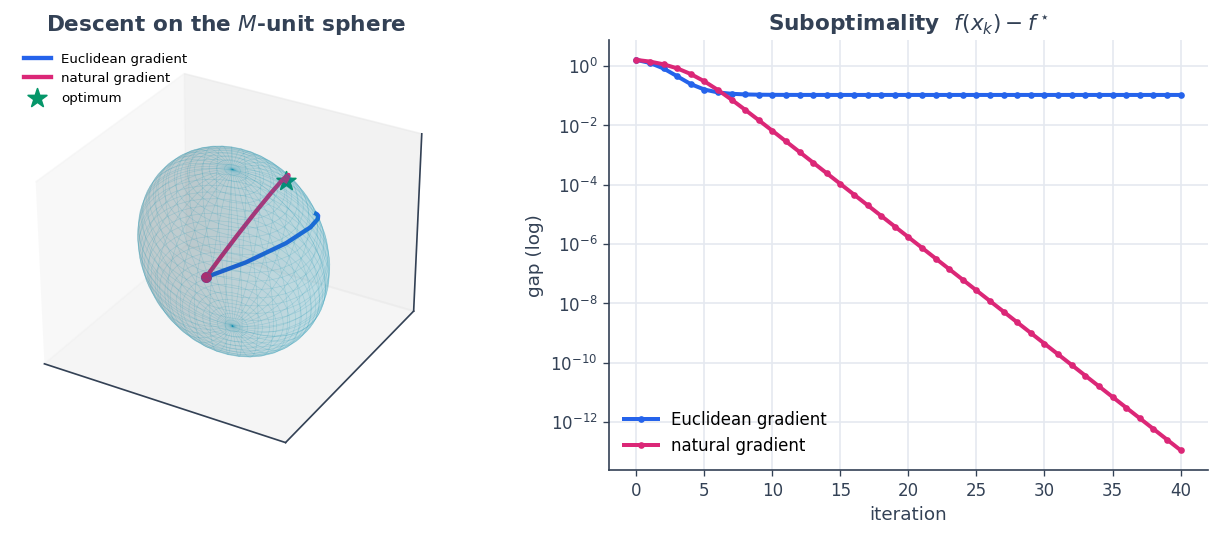
Both runs stay on the ellipsoid and both stop with a tangent residual below
1e-10. Only the metric gradient reaches the minimum; the other run converges
to a feasible stationary point of the wrong problem, so feasibility and a
vanishing step do not certify optimality.
Check your understanding#
Set M to the identity and rerun. Both loops should now coincide, and the answer should be the smallest eigenvector of A.
Why may
_rapply_corereuse_apply_core? The expansion in section 4 is symmetric in v and w for the M-inner product.Replace
retractwith Euclidean normalisationy / np.linalg.norm(y). Which assertion fails first, and why?Raise
etauntil \(\eta(\lambda_{\max}-\lambda_{\min})>2\). Expect the loop to stop converging to the minimiser.
Next: 8 · PDHG for a conic program — operators, cones, and a primal–dual saddle point.