Conversion policy guide#
This tutorial follows tutorials/5_Conversion_Policy.ipynb. It explains why
SpaceCore needs conversion policy, how context is chosen, how dtype is handled
during conversion, and which flags regulate conversion behavior.
Motivation#
SpaceCore is built around the chain:
Spaces and operators always live under a numerical policy: a backend, a dtype, and a checking policy.
As soon as objects may come from different sources, SpaceCore must answer:
Which backend should be used?
Which dtype should be used?
Should native dtype be preserved or converted to the target context dtype?
Should backend changes happen silently or produce warnings/errors?
Without an explicit conversion policy, these situations are ambiguous.
Typical example#
Suppose you create ProductSpace((s1, ..., sn)) without passing ctx=....
The global default context is NumPy with float64, but one input space
sk has a JAX context.
SpaceCore must decide whether to infer context from the input spaces or use the global default context and convert the input spaces. It must also decide what to do with the dtype associated with each input. Conversion policy makes these decisions deterministic.
Context resolution#
The context resolution procedure is:
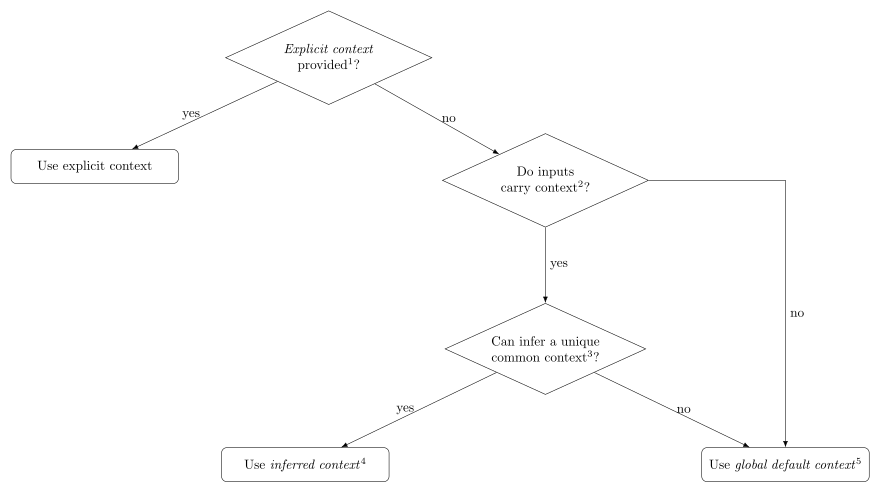
If an explicit context is provided via
ctx, it is used. If it is given as a string, missing context parameters are filled from defaults.If no explicit context is provided and input objects carry
ctxattributes, SpaceCore attempts to infer a context.A common context can be inferred only if all context-carrying inputs use the same backend.
The inferred context uses the shared backend and the most general dtype among the inputs. Other parameters are set to default values.
If no context can be inferred, the global default context set by
spacecore.set_context()is used.
Once the context is resolved, it is assigned to the object being created. Any context-carrying inputs are adapted to the backend of the resolved context. Their dtype may or may not be preserved, depending on the active dtype policy.
How object conversion happens#
Assume an object foo needs to be converted to a new context new_ctx.
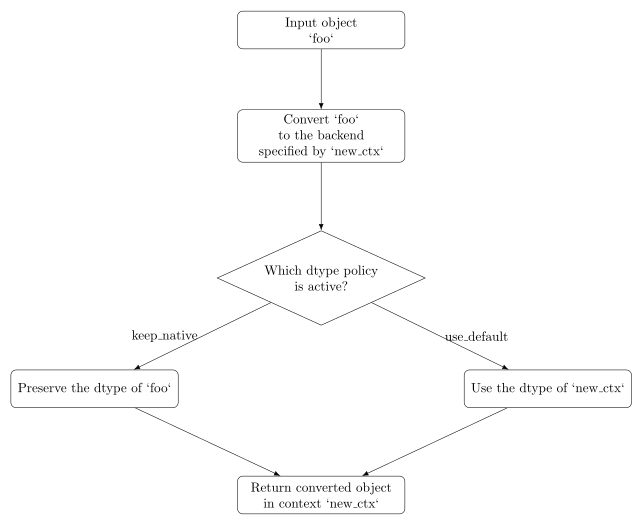
The backend is determined by new_ctx. Dtype is treated independently by
dtype_resolution_policy.
Dtype resolution during conversion#
Dtype resolution is separate from context resolution. Context resolution decides which context is assigned to the object being created. Once that context is fixed, input objects carrying their own contexts may need to be converted to it. During conversion, the backend is determined by the resolved context, but dtype policy may vary.
If an input object has dtype float32 and is converted to a context on a
different backend, SpaceCore must decide whether to preserve float32 or
cast the object to the dtype of the resolved context.
The resolver supports two dtype policies:
dtype_resolution_policy values
convert: convert the object with the dtype that the resolved context provides.keep_native: convert the object to an equivalent dtype in the backend of the resolved context. This is the default.
Set this policy with spacecore.set_dtype_resolution_policy() and inspect it
with spacecore.get_dtype_resolution_policy().
When context is inferred from several objects, dtype is chosen as:
Before joining, dtypes are normalized to the inferred backend.
Other inferred context parameters#
When a context is inferred from several source objects, the inferred
enable_checks flag is the conjunction
Checks remain enabled only if all source contexts have checks enabled.
Resolution policy#
resolution_policy regulates what happens when an object’s native context and
target context are backend-incompatible. That means the object is being
converted to a backend other than its own.
resolution_policy values
warning: conversion is allowed, but a warning is issued. This is the default behavior.error: conversion is rejected. Use this when accidental backend migration should be forbidden.silent: conversion proceeds without warning. Use this when automatic conversion is expected and the pipeline is trusted.
Set this policy with spacecore.set_resolution_policy() and inspect it with
spacecore.get_resolution_policy().
Backend-specific default dtypes#
Each backend implementation defines dtype normalization through
sanitize_dtype(dtype). This method normalizes dtype into backend-native form
and determines the backend default dtype when dtype=None.
For NumpyOps:
For JaxOps, the default depends on JAX configuration:
if
jax_enable_x64=True, the default isfloat64;otherwise, the default is
float32.
Summary#
When a new object is created, SpaceCore resolves context first:
use explicit
ctxif provided;otherwise infer from inputs that carry
ctx;otherwise use the global default context.
Context inference is possible only when context-carrying inputs agree on the
same backend. The inferred dtype is the most general dtype among inputs, and
enable_checks is inferred by conjunction. Once context is resolved, backend
conversion follows resolution_policy and dtype handling follows
dtype_resolution_policy.